

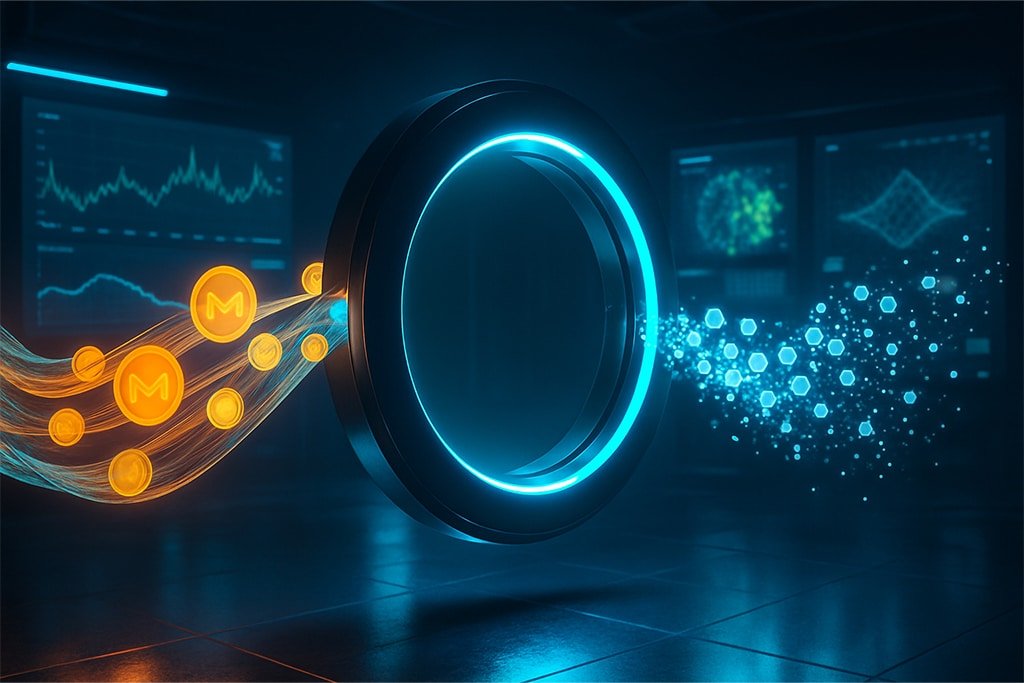
Epoch 172 was far more than just another week of mining in the Qubic network — it marked the launch of a bold, real-world experiment that demonstrated the flexibility and potential of Qubic’s Useful Proof of Work (uPoW) model.
During this epoch, Qubic initiated a dual mining strategy that split network power between two key functions:
- Mining external cryptocurrencies, specifically Monero (XMR) and Tomin (XTM).
- Reinvesting rewards into QUBIC, by executing a buyback-and-burn strategy, while also redistributing part of the earnings as direct rewards to Computors (Qubic miners).
This experiment was not just theoretical. It was carried out in full view of the community, with transparent execution and measurable results.
What actually happened during Epoch 172?
- 517 Monero (XMR) and 6,241,784 Tomin (XTM) were mined by Qubic’s compute power.
- 33.5 billion QUBIC tokens were burned and 33.5 billion were distributed to Computors as mining rewards.
- 50% of mining time was allocated to external mining, while the other 50% was used to train Aigarth, Qubic’s decentralized AI.
- 4,285 Monero blocks were successfully found by the Qubic network.
- The network achieved a peak hashrate of 2.77 GH/s, at times controlling more than half of the Monero network’s hashrate.
- Mining through Qubic’s system was around 3× more profitable than mining Monero directly with the same computational power.
Why was this important?
The experiment served multiple purposes:
- Demonstrate the value of uPoW — showing that Qubic’s computing power can be flexibly allocated to profitable external tasks, while still supporting the Qubic ecosystem.
- Test real-world tokenomics — using emissions for buybacks and burns, and redistributing wealth among active participants, reinforcing both scarcity and incentive.
- Expand network power — by making Qubic mining more rewarding, more CPUs joined the network, strengthening decentralization.
- Advance artificial intelligence — while mining, the network also dedicated computing cycles to training Aigarth, proving multi-purpose functionality.
Community-driven, Transparent, Effective
This wasn’t a top-down decision. The Qubic community voted to allocate emissions between two purposes:
50% toward reducing total supply (burns) and 50% toward incentivizing Computors.
All of this was done transparently, on-chain, and with visible results.
Qubic proved that a decentralized compute network doesn’t have to be limited to one purpose. It can burn tokens, reward contributors, mine external chains, train AI — and do all of it simultaneously in a coordinated, community-led way.


