In the crypto world, few terms trigger as much fear as “51% attack.” Every time a chart goes red or a headline sounds alarming, doubts rise again: could a network really be taken over, manipulated, or even destroyed if someone controls most of its computing power?
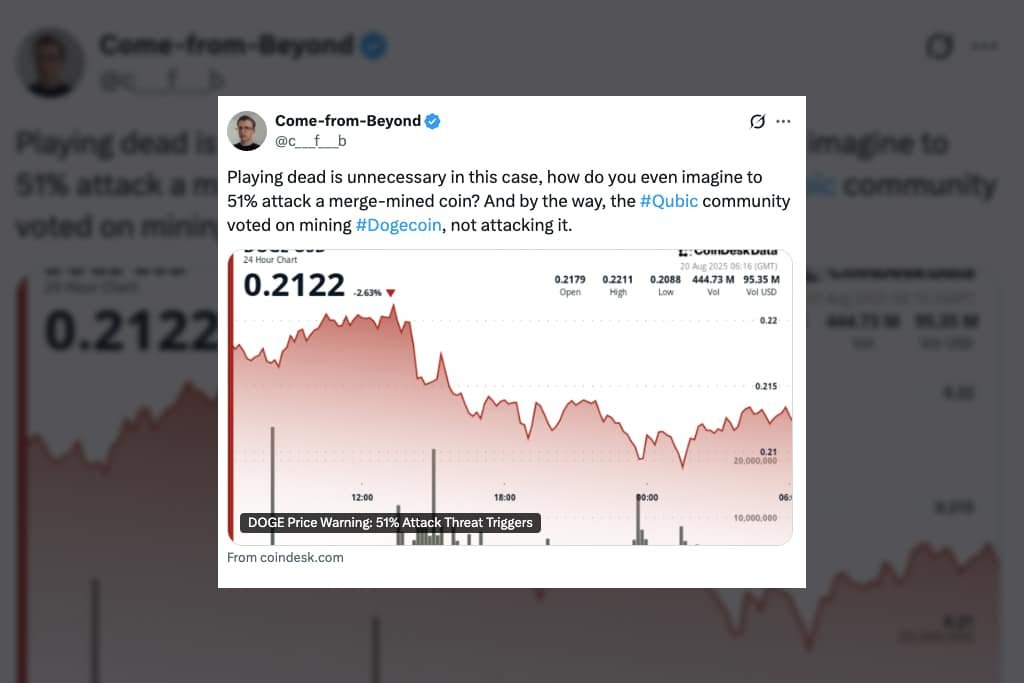
That’s exactly what happened recently with Dogecoin, when some media outlets speculated about a possible 51% attack. But it was Come-from-Beyond (CfB), founder of Qubic, who cut through the noise with a simple, direct post:
“How do you even imagine to 51% attack a merge-mined coin? And by the way, the Qubic community voted on mining Dogecoin, not attacking it.”
Playing dead is unnecessary in this case, how do you even imagine to 51% attack a merge-mined coin? And by the way, the #Qubic community voted on mining #Dogecoin, not attacking it.https://t.co/TVanohSxPG
— Come-from-Beyond (@c___f___b) August 20, 2025
What does this mean?
Dogecoin isn’t standing alone. For years, it has relied on a merge-mining model with Litecoin, which means both coins share the same mining power. In practical terms, if someone wanted to attack Dogecoin, they would also have to dominate Litecoin’s network. That’s not just unlikely — it’s nearly impossible.
CfB’s point is clear: there’s no reason to panic, and no need to imagine science-fiction scenarios. Dogecoin is structurally protected.
Qubic doesn’t attack, Qubic mines
Another key message is CfB’s clarification of Qubic’s role. What Qubic does is not “attacking” coins, but mining them together, leveraging its distributed computing power model.
In fact, the Qubic community voted openly and transparently: the next coin to integrate into its mining efforts is Dogecoin. This isn’t a war. It’s a collective exercise, where the community decides where to direct its computational resources.
Beyond the Fear
What’s interesting about this episode is how Qubic once again proves that narratives matter as much as technology. While some outlets lean on alarmist headlines, the reality is that the community is building, not destroying. Qubic isn’t playing the villain in the shadows; it’s playing the role of an engine — one that integrates, pushes boundaries, and opens new possibilities for decentralized mining.
In short, what first looked like a threat turns out to be something else entirely: proof that when a community decides together, even the “impossible” starts to look achievable.