

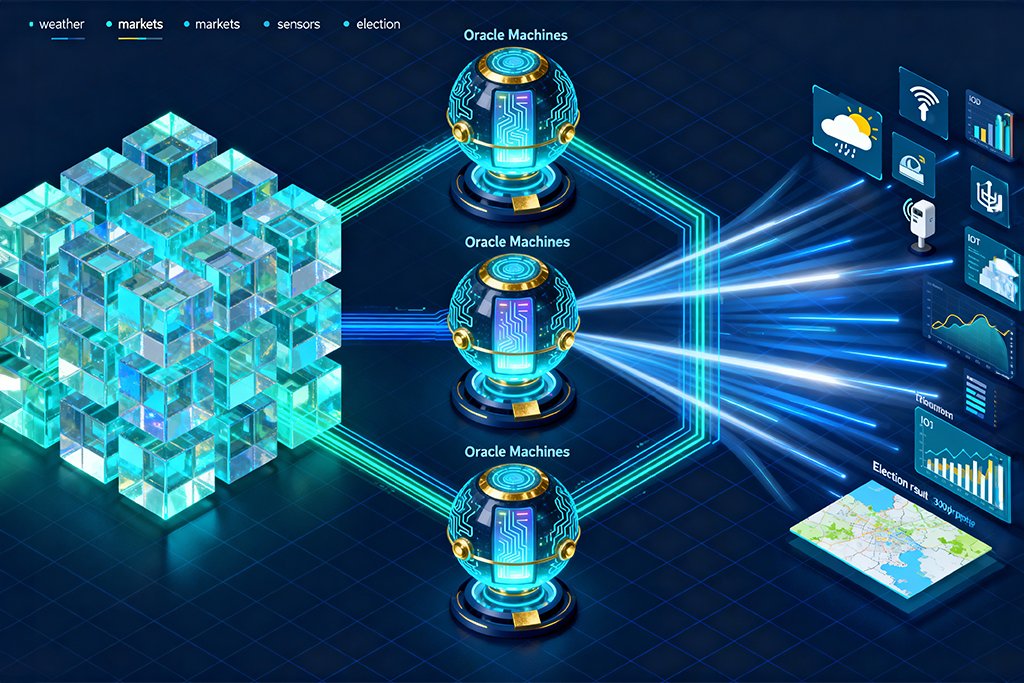
A smart contract is only as powerful as the data it can access. On their own, smart contracts live in a closed ecosystem: they can only “see” what happens inside their blockchain. That’s where oracles change the game.
What are blockchain oracles?
Oracles are systems that act as bridges between the blockchain and the real world.
A smart contract without an oracle can execute instructions automatically—but only based on on-chain data. That makes it extremely limited.
Simple example: imagine an insurance contract that must pay out if it rains in a certain city. On its own, the contract has no way of knowing whether it rained. It needs an oracle to fetch and validate that weather data from outside.
In short: oracles expand the reach of blockchain by connecting it to external information like asset prices, sensor readings, sports scores, or even election results.
Types of oracles
- Software: collect data from the web (e.g., prices or statistics) and pass it to the blockchain.
- Hardware: use physical sensors to provide real-world information like temperature or humidity.
- Human: individuals who validate or provide off-chain data.
Regardless of type, their core function is the same: giving smart contracts access to reliable external information.
The problem with traditional oracles
This is where the Oracle Problem comes in:
How can we ensure that external data is correct and not manipulated?
Centralized oracles rely on a single source or validator. That creates a single point of failure, weakening both the security and decentralization of the entire system.
Oracle machines in Qubic: a natural evolution
Qubic introduces Oracle Machines as a core part of its architecture.
The difference is fundamental: instead of being external services, Oracle Machines are integrated into the network’s consensus mechanism.
This means:
- No dependence on single points of failure.
- External data is validated within consensus, ensuring security and decentralization.
- They become a native component of the system, not just an external patch.
In practice, Oracle Machines can fetch data like asset prices, weather reports, election results, or sensor inputs—and make them usable for both smart contracts and AI processes.
Why are they essential for Qubic and Aigarth?
Qubic isn’t just aiming to make smart contracts more useful. Its vision goes further: to build decentralized intelligence.
In Aigarth, billions of neural networks evolve autonomously. For that intelligence to avoid living in a vacuum, it needs access to real, reliable data.
That’s where Oracle Machines come in.
- They expand Aigarth’s vision.
- They provide the emerging intelligence with information from the real world.
- They enable Useful Proof of Work not only to train AI, but to connect it with real-time reality.
In other words: without oracles, smart contracts are blind. With Oracle Machines, Qubic opens the eyes of its intelligence to the world.
A clear signal
Oracles have always been a critical piece of the blockchain ecosystem, but in Qubic they become something more: an inseparable part of consensus. This not only eliminates weaknesses but strengthens the path toward the real goal: a system where blockchain and artificial intelligence evolve together, connected to the real world.


