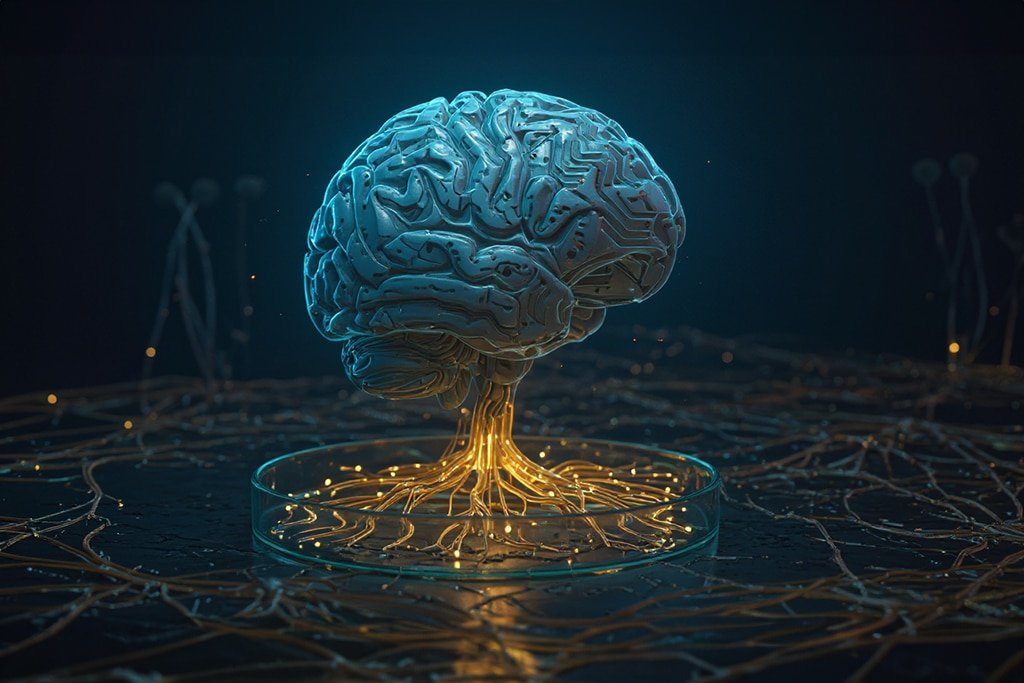
Last week marked an important step for Qubic: the Aigarth team released the first open-source code for several of the core components behind their vision of True AI. Among these are the ternary neural mechanism, the evolutionary building blocks, the growth rules, and even the first arithmetic operations used to test how the system behaves.
What is Aigarth?
Qubic uses the metaphor of a garden to explain Aigarth. The idea is not to design an AI in a traditional sense, but to create the right conditions for it to grow. Just as plants need soil, water, and time, Artificial General Intelligence (AGI) needs a mathematical “soil,” rules for growth, and mechanisms for evolution.
The Aigarth team highlights three pillars that are already visible:
- Aigarth Intelligent Tissue (AIT): the mathematical substrate, like the soil of the garden, where digital “organisms” can grow.
- Ternary computing: instead of only yes/no, true/false, AIT adds a third state: unknown. This mirrors how biological neurons work, sometimes resting, sometimes excited, and sometimes inhibited.
- Evolutionary dynamics: the garden analogy continues here. The digital organisms that “work” survive and evolve, while the less effective ones fade out. Over time, the system improves on its own.
The Role of AIT
The AIT release is not meant to be a finished product. Instead, it is described as a kind of programmable Petri dish where small computational units (Intelligent Tissue Units, or ITUs) can self-modify, adapt, and compete.
These ITUs operate in ternary logic (−1, 0, +1), which is closer to how neurons function in the brain than simple binary. They exchange signals, make predictions, and update themselves. With each cycle, the system decides whether to stabilize, keep running, or grow new connections.
Another important aspect: every ITU carries its own record of changes. Data, experiments, and results are cryptographically tracked and saved, so anyone can verify or reproduce what happened.
First Applications: “Anna”
The first demonstration, once nicknamed “Anna,” shows AIT solving basic addition with eight-bit numbers. It’s not about replacing a calculator, but about creating a laboratory for evolution. The tissue records results across many trials, which allows researchers to see which changes are genuine improvements.
AIT also runs without the need for expensive hardware. It is CPU-first and can work across distributed clusters, making it accessible and opening participation to a much wider community.
Why This Matters
This release connects to a decade of research on new computing approaches, like cellular automata and ternary quantization, which show that systems with an “unknown” state can be more efficient and resilient. By opening AIT to the public, Qubic is creating a playground where scientists, developers, and enthusiasts can test new ideas and approaches to intelligence.
From the beginning, Qubic has embedded ethical principles into its framework. The license prohibits military applications and highlights the risks of misuse or bias.
Looking Forward
The Aigarth Intelligent Tissue release is not the final destination. Instead, it is the first step in an open call to the broader community: test it, experiment with it, and help shape what comes next.
It is Qubic’s invitation to participate in the long journey toward AGI.