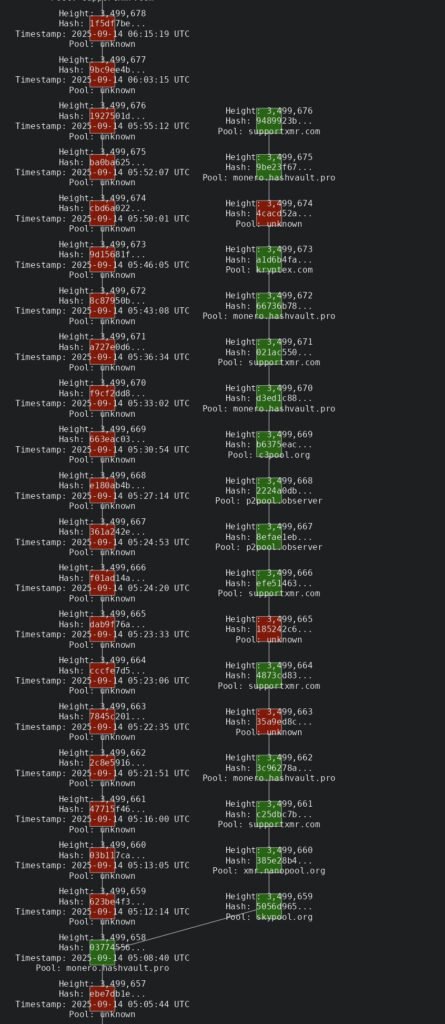
What you’re seeing in the image is a “timeline edit.” A blockchain grows like a line of stamped pages. Now and then the last pages can be replaced if a stronger line appears. That replacement is called a reorganization, or reorg. On September 14, Monero’s chain rewrote 18 pages at once—blocks 3,499,659 → 3,499,676—which invalidated 118 transactions. For many networks, losing that many fresh pages would be a crisis. After so much prior noise, it’s being treated as routine. It shouldn’t be.
Why did it happen? Because Qubic has been using selfish-mining strategies and regularly pushes past 51% of Monero’s hash power. With enough compute, a miner can privately build a longer chain and then publish it, forcing the network to accept the rewrite.
Two weeks earlier, Qubic publicly warned it could orphan up to 16 blocks on Monero during epoch 175, but voluntarily capped the action at 9 to avoid any risk of double-spend. Since then, centralized exchanges raised the number of confirmations they require before crediting deposits. That change made the 18-block reorg safe to perform from an exchange-risk point of view—but it also underscores the underlying issue on the Monero side: when one actor can consistently out-muscle the rest, recent history is negotiable.
If you’re not technical, think of it like this: imagine a town ledger where the last few lines can be replaced if someone brings a “more complete” copy signed by more clerks. If one printing press runs faster than all the others combined, it can keep replacing the end of the ledger whenever it wants. Shops can protect themselves by waiting for more lines before accepting payment (that’s what exchanges did), but the vulnerability remains unless the balance of printing power changes.
The takeaway isn’t hysteria; it’s clarity. A reorg of this size is the largest recorded to date and a reminder that hash distribution and confirmation policies are not trivia—they are the safety rails. Calling it “business as usual” papers over a real pressure point.