In the crypto world, discussions often circle around prices, listings, and markets. But one fundamental question is rarely asked: does all the effort of mining or staking actually serve any purpose beyond simply keeping a network alive?
This question opens the door to a deeper comparison between three models: Proof of Work (PoW), Proof of Stake (PoS), and the new approach proposed by Qubic with uPoW (Useful Proof of Work).
Proof of Work (PoW): Security at a Heavy Price
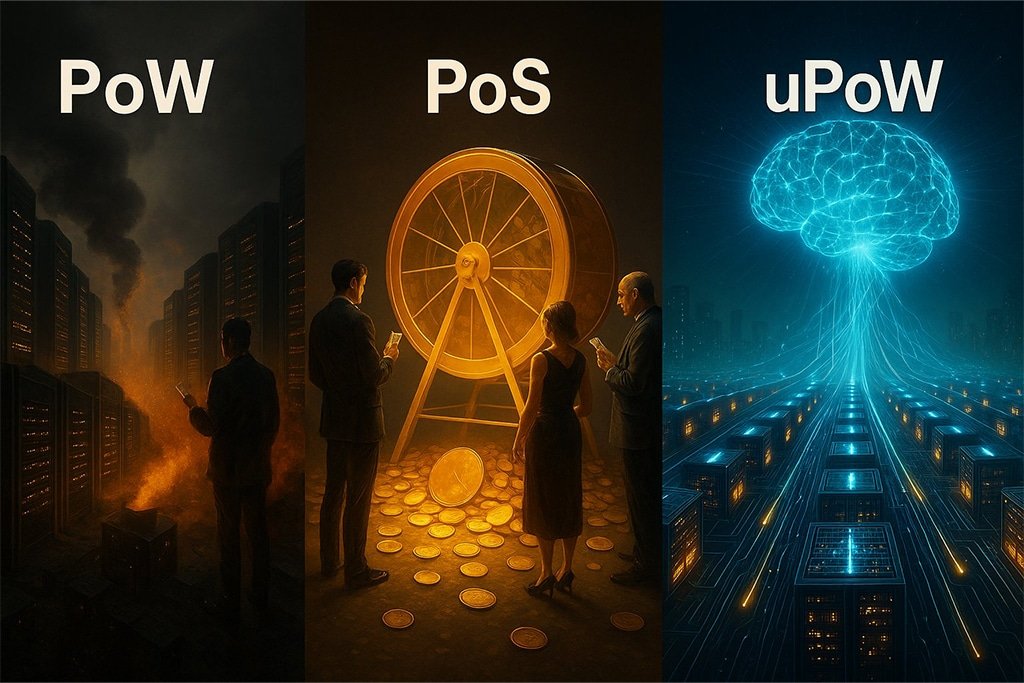
Bitcoin pioneered Proof of Work (PoW). The system is simple: millions of computers compete to solve mathematical puzzles with no purpose beyond network security. The first to succeed validates the block and earns the reward.
No one can deny that PoW has been one of the most secure mechanisms ever created. It is straightforward, battle-tested, and has defended Bitcoin for more than a decade. But the cost is brutal—enormous amounts of electricity consumed, with computational power ending up as nothing more than heat. The work secures the chain, yes, but it produces nothing else.
Proof of Stake (PoS): Efficiency With a Bias
Later came Proof of Stake (PoS), a concept first introduced by CfB, the same mind now behind Qubic. Ethereum adopted it in September 2022, marking a turning point in blockchain history.
Instead of relying on machines, PoS revolves around capital. The more coins you lock as collateral, the higher your chances of validating a block. It works like a lottery in which the number of tickets depends on your holdings.
The advantage of Proof of Stake (PoS) is obvious: it consumes far less energy, eliminating the need for endless warehouses of hardware. But it carries a structural flaw: those with more coins gain more opportunities, earn more rewards, and consolidate their position. Wealth, instead of being distributed, tends to concentrate.
uPoW (Useful Proof of Work): Qubic’s Proposal
This is where Qubic introduces a radical shift with uPoW (Useful Proof of Work). The idea is almost obvious once you hear it: if CPUs are going to run anyway, why waste them on meaningless puzzles or lotteries?
With uPoW, every machine on the network performs tasks that create tangible value: training artificial intelligence models, running machine learning processes, and contributing to Aigarth, a decentralized intelligence that grows with every CPU cycle.
In Qubic, nothing is wasted. The energy that in PoW is lost as heat becomes knowledge. The capital that in PoS reinforces wealth concentration is here transformed into collective intelligence.
The Comparison Made Clear
- Proof of Work (PoW) turns electricity into security.
- Proof of Stake (PoS) turns locked coins into security.
- uPoW (Useful Proof of Work) turns computation into intelligence.
Final Reflection
Early blockchains secured themselves with brute force—either wasted computation or immobilized capital. Qubic, under the vision of CfB, argues that the same effort should be used for something greater: building decentralized intelligence and giving computation a real purpose.
The future of blockchain should not be survival alone. It should be creation.
And in that horizon, uPoW (Useful Proof of Work) is not just an improvement—it is a paradigm shift.